

Keeping up with the military industry news from the world
Provided by AGP
Vadzo Imaging Launches Innova-678CRS, a 4K HDR GigE PoE Camera Built on Sony STARVIS 2 IMX678
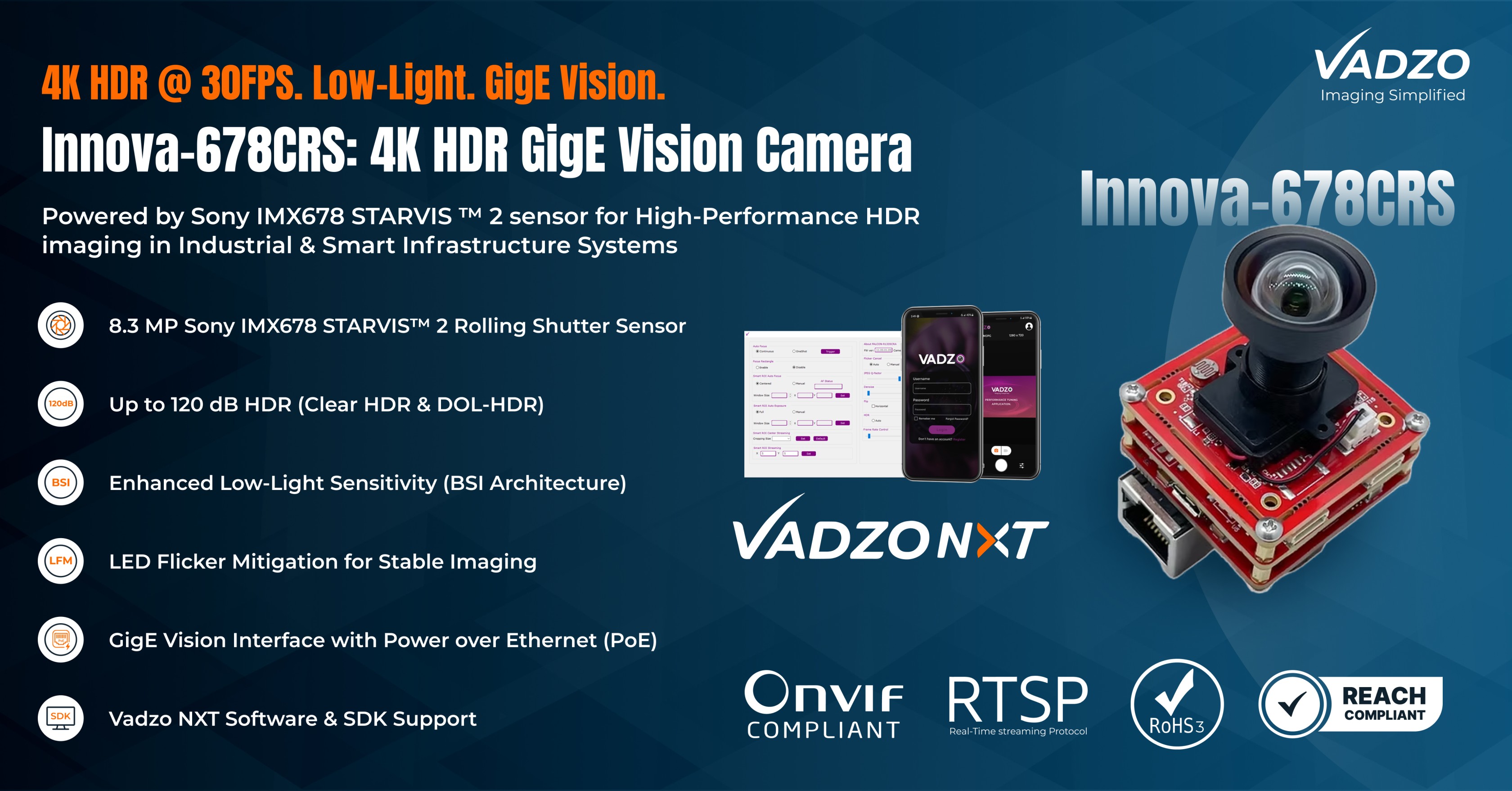
8.4MP 4K Gigabit Ethernet HDR camera with LED flicker mitigation, and ONVIF Profile S, T, G and M compliance targets industrial inspection, traffic monitoring.
TOKYO, TOKYO, JAPAN, May 22, 2026 /EINPresswire.com/ -- Vadzo Imaging today announced the Innova-678CRS, an IMX678 4K HDR Gigabit Ethernet PoE camera built on the Sony STARVIS™ 2 IMX678 CMOS sensor. Featuring Clear HDR and Digital Overlap HDR modes delivering up to 120+ dB dynamic range, BSI pixel architecture for reliable low-light and nighttime performance, LED flicker mitigation for stable operation under artificial lighting, and ONVIF Profile S, T, G and M compliance, the Innova-678CRS is purpose-built for industrial inspection, traffic and smart city monitoring, robotics, and distributed multi-camera vision architectures where consistent image quality under variable and challenging lighting is a hard operational requirement.
Technical Highlights
4K Resolution at 8.4MP: The IMX678 sensor delivers 8.4MP resolution (3856 × 2180) at 30 fps. High pixel density supports accurate detection of fine surface defects, dimensional variations, and subtle inconsistencies across wide inspection fields — enabling reliable quality control and AI-based vision pipelines without sacrificing spatial coverage for resolution.
Clear HDR and DOL-HDR up to 120+ dB: The Innova-678CRS 4K HDR Ethernet camera supports two HDR modes. Clear HDR combines multiple exposures to extend dynamic range while preserving detail in both highlights and shadows within a single output frame. Digital Overlap HDR (DOL-HDR) achieves up to 120+ dB by interleaving short and long exposure frames at the sensor level, maintaining temporal coherence on moving subjects where sequential frame-based HDR would introduce motion artefacts. This ensures consistent image quality in scenes with glare, deep shadows, and mixed backlighting — conditions that cause false positives and missed detections in standard WDR cameras.
Sony STARVIS 2 BSI Architecture for Low-Light Performance: The IMX678's back-illuminated stacked pixel design delivers high sensitivity and low noise at reduced illumination levels. This enables reliable image capture in nighttime, dusk, and dimly lit indoor environments, reducing dependence on supplemental illumination infrastructure and simplifying system design in deployments where lighting cannot be controlled.
LED Flicker Mitigation: Modern warehouse, factory, and street lighting environments use LED sources that cycle at frequencies that interact with standard camera shutter timing, producing frame-to-frame intensity variation that destabilizes detection and tracking algorithms. The Innova-678CRS integrates LED flicker mitigation, synchronizing shutter operation to suppress these intensity fluctuations and deliver stable frame-to-frame consistency under artificial lighting across all standard LED frequencies.
Gigabit Ethernet with PoE: The Innova-678CRS delivers image data over Gigabit Ethernet with PoE compliant with IEEE 802.3af, combining data and power over a single cable. This eliminates separate power routing to each camera node, supports long-distance deployment across factory floors and outdoor infrastructure, and enables multi-camera architectures managed through standard network infrastructure without dedicated vision hardware at each node.
Scalable Multi-Camera Integration: GigE connectivity supports synchronized multi-camera architectures for wide-area inspection, surround-view monitoring, and coordinated data capture across large facilities. Centralized processing of synchronized streams across distributed nodes is managed through standard network infrastructure without per-camera frame grabbers or dedicated capture hardware.
ONVIF Profile S, T, G and M Compliance: ONVIF Profile S covers basic video streaming and device control. Profile T adds H.264/H.265 streaming and metadata for integration with smart factory and analytics platforms. Profile G enables onboard storage and event-based recording. Profile M extends interoperability to analytics metadata, enabling the Innova-678CRS to feed detection events and object metadata directly into ONVIF-compliant VMS and automation ecosystems without custom middleware.
Vadzo NXT Platform and VISPA NXT SDK: The Innova-678CRS is supported by the Vadzo NXT software platform and VISPA NXT SDK, providing network discovery, IP configuration, live streaming, failsafe firmware update, and advanced control over exposure, gain, and HDR mode parameters. VISPA NXT SDK APIs are available in C, C++, C#, and Python, with browser-based access via Chrome, Firefox, and Edge. Deployment is supported across Windows, Linux, Android, and embedded edge AI systems.
Targeted Application Domains
Industrial Inspection and Quality Control: Production line inspection under mixed ambient and task lighting presents a fundamental HDR problem — specular metal surfaces reflect task lighting into highlight clipping while recessed or shadowed areas fall below the noise floor of standard WDR cameras. The Innova-678CRS DOL-HDR mode maintains simultaneous detail in both regions within a single frame, enabling reliable micro-defect detection, dimensional measurement, and surface variation analysis on mixed-finish parts without per-SKU illumination reconfiguration. At 8.4MP, pixel density is sufficient for sub-pixel dimensional analysis across wide inspection fields without multiple camera coverage zones.
Robotics and AGV Systems: Industrial robots and AGVs operating in facilities with mixed fluorescent and LED lighting zones encounter frame-to-frame luminance instability that causes feature detection and barcode reading failures at zone transitions. The Innova-678CRS LED flicker mitigation stabilizes exposure across lighting transitions, while Clear HDR maintains consistent contrast on navigation targets and barcodes under high-contrast scene conditions. GigE and PoE simplify camera mounting on robotic arms and AGV chassis without dedicated power routing.
Traffic Monitoring and Smart City Infrastructure: Vehicle and pedestrian detection in outdoor environments must handle the full dynamic range between direct sunlight on light-colored surfaces and deep shadow under bridges and overpasses. DOL-HDR at 120+ dB maintains readable plate and pedestrian detail simultaneously across this range. LED flicker mitigation ensures stable detection under variable-frequency LED street lighting, and PoE enables single-cable deployment on poles and gantries without separate power infrastructure at each camera location.
Distributed and Multi-Camera Vision Systems: Wide-area warehouse monitoring, perimeter surveillance, and surround-view factory inspection require camera networks that can be deployed, managed, and scaled without per-camera hardware infrastructure. The Innova-678CRS GigE connectivity and ONVIF Profile S, T, G and M compliance allow camera networks to be managed through standard VMS platforms with no custom drivers, while synchronized multi-camera capture over standard network switches enables coordinated wide-area coverage across facilities of any scale.
Low-Light and Nighttime Monitoring: Security, fleet, and event monitoring installations require cameras that maintain usable image quality after dark without high-power visible illumination. The IMX678 STARVIS 2 BSI architecture delivers reliable capture under NIR and low-level ambient illumination, while DOL-HDR handles the contrast range between illuminated areas and unlit backgrounds. This reduces illumination infrastructure cost per camera node and extends monitoring capability into environments where visible illumination is impractical or prohibited.
Aerial and Mobile Vision Systems: UAV inspection and mobile surveillance platforms encounter rapidly changing illumination as viewing angle and sun position shift during flight. Standard WDR cameras clip highlights during upward-facing capture and lose shadow detail in ground-facing frames within the same mission. The Innova-678CRS 120+ dB HDR range accommodates this variation within a single exposure mode configuration, reducing the need for per-mission camera parameter adjustment and maintaining consistent output across a full inspection flight.
Frequently Asked Questions
What is the operational difference between Clear HDR and DOL-HDR, and when should each be used in machine vision deployments?
Clear HDR combines multiple sequential exposures into a single output frame through tone mapping, extending dynamic range while maintaining natural-looking output. It is suited for static or slow-moving scenes where inter-frame motion between exposures is negligible. DOL-HDR interleaves short and long exposure lines at the sensor level within a single readout cycle, eliminating inter-frame motion between the two exposure components. This makes DOL-HDR the correct mode for moving subjects where the motion artefacts introduced by sequential Clear HDR would degrade detection accuracy or produce measurement errors.
Why does LED flicker cause problems for industrial and traffic camera deployments, and how does mitigation work?
LED lighting sources cycle at twice the mains frequency, 100 Hz in 50 Hz regions, 120 Hz in 60 Hz regions. At standard camera frame rates and shutter speeds, the shutter open period does not consistently align with the LED cycle, causing different frames to capture the LED at different points in its intensity waveform. The result is frame-to-frame luminance variation that is invisible to the human eye but causes significant instability in machine vision detection algorithms, OCR pipelines, and tracking systems that rely on frame-to-frame consistency. LED flicker mitigation synchronizes shutter timing to the LED cycle, ensuring every frame captures the same point in the illumination waveform and eliminating this variation.
What does ONVIF Profile M compliance enable that Profile S and T do not cover?
Profile S covers video streaming, PTZ control, and basic device management. Profile T adds H.264/H.265 streaming and event metadata. Profile M extends the standard to analytics metadata, structured data describing detected objects, classifications, and events, allowing the Innova-678CRS to output detection results and object metadata in a standardized format that ONVIF-compliant VMS and automation platforms can consume directly without custom integration middleware. For smart factory and smart city deployments where camera output feeds into analytics dashboards or automated response systems, Profile M compliance is the enabler of standards-based analytics integration.
What infrastructure is required to deploy a multi-camera Innova-678CRS network across a large facility?
The Innova-678CRS requires only standard Gigabit Ethernet infrastructure. No frame grabbers, no proprietary network hardware, and no dedicated vision network are required. ONVIF compliance means camera discovery, configuration, and stream management can be handled through any ONVIF-compliant VMS without custom drivers. For large deployments, cameras can be added to an existing enterprise or industrial network without infrastructure changes beyond switch port provisioning and IP address assignment.
How does the IMX678 STARVIS 2 BSI architecture improve low-light performance compared to standard front-illuminated sensors?
Front-illuminated sensors place the metal wiring layer above the photodiode, blocking a portion of incident light before it reaches the light-sensitive area. Back-illuminated sensors invert this architecture, placing the wiring layer behind the photodiode so that incident light reaches the photodiode directly without obstruction. This increases quantum efficiency across all wavelengths but particularly in low-light conditions where photon count is limited. The STARVIS 2 generation combines BSI architecture with additional low-noise readout circuitry, further improving signal-to-noise ratio at high gain settings needed for nighttime and dimly lit deployments.
Availability
The Innova-678CRS is available for OEM evaluation and production deployment. Engineering samples, evaluation kits, and detailed technical documentation are available at www.vadzoimaging.com. For volume pricing and OEM customization inquiries, contact support@vadzoimaging.com or call +1 817-678-2139.
About Vadzo Imaging
Vadzo Imaging designs and manufactures embedded and machine vision cameras for OEMs and system integrators. The company offers imaging platforms across USB, MIPI, GigE, and SerDes interfaces, with in-house development across sensor selection, optics, ISP tuning, firmware, and interface stacks — including UVC, Meridian (in-house ONVIF stack), and Vortex (in-house RTSP stack). Vadzo supports edge AI integration and provides OEM customization across hardware, firmware, and software for applications in industrial automation, robotics, smart surveillance, and life sciences.
Alwin Vincent
Vadzo Imaging
+1 817-678-2139
email us here
Visit us on social media:
LinkedIn
YouTube
X
Legal Disclaimer:
EIN Presswire provides this news content "as is" without warranty of any kind. We do not accept any responsibility or liability for the accuracy, content, images, videos, licenses, completeness, legality, or reliability of the information contained in this article. If you have any complaints or copyright issues related to this article, kindly contact the author above.
