

Defense Cyber Security Market Set to Surpass US$43.4 Billion by 2031, at a CAGR of 7.7%
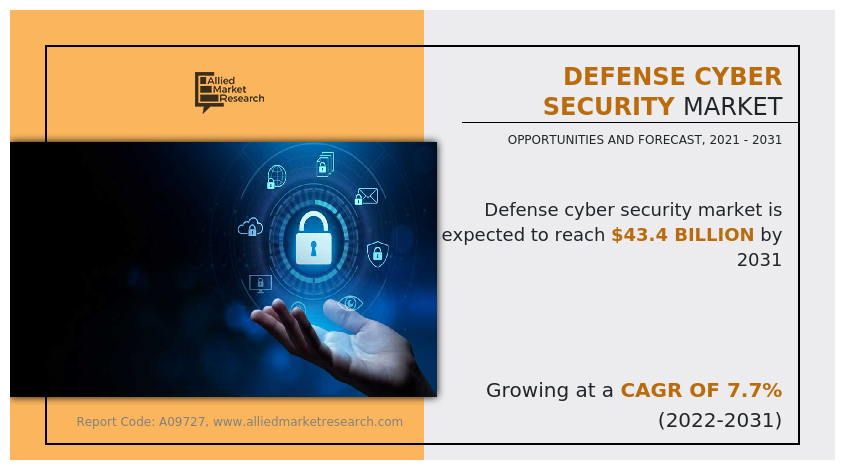
Defense Cyber Security Market (2021 - 2031) Size, Share, Competitive Landscape and Trend Analysis Report, by Type, by Deployment, by Solution, by Application.
WILMINGTON, DE, UNITED STATES, June 16, 2026 /EINPresswire.com/ -- According to the report, the global defense cyber security market generated $21.3 billion in 2021, and is estimated to reach $43.4 billion by 2031, witnessing a CAGR of 7.7% from 2022 to 2031. The report offers a detailed analysis of changing market trends, top segments, key investment pockets, value chain, regional landscape, and competitive scenario.A growing risk of cyber threat to critical infrastructures by structured criminal groups, technological improvement in the cyber security industry, increase in demand for defense IT expenditure, transition of conventional military aircrafts into autonomous aircrafts, and increased dependency of military organizations on the internet drive the growth of the global defense cyber security market. However, limited awareness related to cyber security and lack of cyber security professionals or workforce hamper the global market growth. On the other hand, increase in threats and warnings related to cyber-attack on officials and adoption of IoT in cyber security technology present new growth opportunities for the global market in the coming years.
Download Report Sample - https://www.alliedmarketresearch.com/request-sample/A09727
The growing demand for defense-system to be present against cyber-attacks across the globe. In accordance with segmentation, "by type, the Endpoint security solutions segment dominated the global Defense Cyber Security market in 2021, in terms of revenue. By deployment, the on-premises segment dominated the global defense cyber security market in 2021, in terms of revenue. By solution, the identity and access management segment application, the military segment dominated the global Defense Cyber Security market in 2021, in terms of revenue. Presently, North America is the highest revenue contributor and expected to lead the market during the forecast period, followed by Europe.
The concept of defense cyber security is typically attributed to a series of security protocols and controls that are layered throughout an IT network to preserve the integrity and privacy of defense organizations. Every organization has vulnerabilities that an attacker can exploit to gain access and cause damage. Hence, the in depth strategy of defense cyber security is to protect against a wide range of threats and close all of an organization's security holes in order to protect it effectively against cyber threats.
LIMITED-TIME OFFER - Buy Now & Get Exclusive Discount on this Report @ https://www.alliedmarketresearch.com/checkout-final/df5f26780258ef48ebb6542d66be5605
Furthermore, implementing IT solutions in defense operations has become significant, owing to the growing evolution in the type and occurrence of attacks across the globe. This is anticipated to surge in demand for innovative and modern technologies such as 5G, artificial intelligence, cloud computing, data analytics, cyber security, and autonomous systems across various defense systems. For the past few years, major defense companies such as Thales Group, Northrop Grumman Corporation, Safran SA, and others have established long term contracts with several countries' governments and governing bodies to install defense cyber security systems. For instance, in September 2020, Northrop Grumman Corporation awarded a task order contract by the U.S. General Services Administration's (GSA) Federal Systems Integration and Management Center (FEDSIM) and the Defense Intelligence Agency, to help the organization deliver actionable intelligence with speed and enhance decision superiority.
In addition, the defense cyber security market has witnessed significant growth in recent years, owing to the increased dependency of military organizations on the internet network, growing advancements in information technology, and increasing government initiatives to secure critical data. For instance, in March 2021, the government announced its plans regarding National Cyber Force and set up a Cyber Corridor in north of England. This is expected to set out the importance of cyber security to the country's defense, extending from cyber enhanced battlefield capabilities for the armed forces to internet security for household users.
Also, the increased adoption of machine-to-machine technologies in the aerospace domain and the focus of the governments on enhancing cyber security to counter cyber terrorism has led to the growth of the cyber security market in this sector in the past decade. For instance, in October 2022, BAE Systems introduced a new maintenance capability, Viper Memory Loader Verifier II (MLV II), to defend the onboard systems of F-16 fighter aircraft from cyber-attacks. The new system helps increase the aircraft defense against cyber threats and provides the flight-critical ability to install and verify various software and mission data files onto the aircraft. Furthermore, the companies operating in the defense cyber security market have adopted partnerships, investments, and product launches to increase their market share and expand their geographical presence. For instance, in August 2022, Raytheon Intelligence & Space, a Raytheon Technologies business, entered into a partnership with CrowdStrike, a leader in cloud-delivered protection of endpoints, cloud workloads, identity, and data, to integrate its complementary endpoint security products into RI&S' Managed Detection and Response (MDR) service.
For Purchase Enquiry: https://www.alliedmarketresearch.com/purchase-enquiry/A09727
The factors such as increase in demand for defense IT expenditure, transition, of conventional military aircraft into autonomous aircraft, and growth in cyber-attacks on the regulatory, trade and individuals supplement the growth of the defense cyber security market. However, limited awareness related to cyber security and lack of cyber security professionals or workforce are the factors expected to hamper the growth of the defense cyber security market. In addition, increasing threats and warnings related to cyber-attack on officials and adoption of IoT in cyber security technology creates market opportunities for the key players operating in the defense cyber security market.
Based on region, North America was the largest market in 2021, capturing nearly one-third of the global defense cyber security industry share, owing to increasing investment in cyber security services by many companies in the region. However, Asia-Pacific is expected to lead in terms of revenue and manifest the fastest CAGR of 9.2% during the forecast period. This is due to the high rate of modernization of police force, increased annual budgetary spending on homeland security, and rise in instances of terrorist activities in the region.
Leading Market Players
Intel Corporation
AT&T Inc.
Northrop Grumman
IBM Corporation
Lockheed Martin Corporation
BAE Systems plc
Thales
EclecticIQ B.V.
SentinelOne
Boeing
DXC Technology Company
Cisco Systems, Inc.
Raytheon Technologies Corporation
Secureworks, Inc.
Privacera, Inc.
Trending Reports:
Military Cybersecurity Market: https://www.alliedmarketresearch.com/military-cybersecurity-market-A323349
Aerospace Cyber Security Market: https://www.alliedmarketresearch.com/aerospace-cyber-security-market-A09068
Cyber Weapons Market: https://www.alliedmarketresearch.com/cyber-weapons-market-A50260
David Correa
Allied Market Research
+ + + + + + + + + + + + + +1 800-792-5285
email us here
Visit us on social media:
LinkedIn
Facebook
YouTube
X
What Sets Us Apart ? - Allied Market Research
Legal Disclaimer:
EIN Presswire provides this news content "as is" without warranty of any kind. We do not accept any responsibility or liability for the accuracy, content, images, videos, licenses, completeness, legality, or reliability of the information contained in this article. If you have any complaints or copyright issues related to this article, kindly contact the author above.
